Health

Take care of your health

Nature of life

It goes on.

Future

welcome to the future

Present

Future just ahed

Feel

Save Nature

Showing posts with label Donald Trump. Show all posts

Monday, 26 June 2017

Trump urges India's Modi to fix deficit, but stresses strong ties

U.S. President Donald Trump urged Indian Prime Minister Narendra Modi to do more to relax Indian trade barriers on Monday during talks in which both leaders took great pains to stress the importance of a strong U.S.-Indian relationship.

At a closely watched first meeting between the two, Trump and Modi appeared to get along well. Modi pulled in Trump for a bear hug on the stage as the cameras rolled in the Rose Garden.

“I deeply appreciate your strong commitment to the enhancement of our bilateral relations," Modi told him. "I am sure that under your leadership a mutually beneficial strategic partnership will gain new strength, new positivity, and will reach new heights.”

Trump was also warm but made clear he sees a need for more balance in the U.S.-India trade relationship in keeping with his campaign promise to expand American exports and create more jobs at home. Last year the U.S. trade deficit with India neared $31 billion.

Trump said he would like a trading relationship that is "fair and reciprocal."

"It is important that barriers be removed to the export of U.S. goods into your markets and that we reduce our trade deficit with your country," he said.

Trump said he was pleased about an Indian airline’s recent order of 100 new American planes and that the United States looked forward to exporting more energy, including major long-term contracts to purchase American natural gas.

These energy contracts "are being negotiated and we will sign – trying to get the price up a little bit," Trump said.

Modi came to Washington looking to revitalize a relationship that thrived under former President Barack Obama but has appeared to flag as Trump courted India's rival China in an effort to persuade Beijing to do more to rein in North Korea.

Modi effusively praised Trump, hailing his “vast and successful experience in the business world” and “great leadership” for U.S.-India ties, which he said should “lend an aggressive and forward looking agenda to our relations.”
Trump accepted Modi's invitation to visit India, the White House said in a statement, but no time frame was given for the trip.

Modi harked back to Trump's "Make America Great Again" campaign slogan to stress that his agenda for his country was little different than Trump's.

"I am sure that the convergence of my vision for "New India" and President Trump’s vision for making America great again will add new dimensions to our cooperation," he said.

Trump did not mention U.S. differences with India on immigration and the Paris climate accord.

"The future of our partnership has never looked brighter," Trump said as both leaders underscored the importance of the defense and security relationship.

AVIATION DEALS

As they met, a Pentagon agency said the U.S. State Department has approved the possible sale to India of a Boeing C-17 transport aircraft with an estimated cost of $366 million.

The United States also has offered to sell a naval variant of the Predator drone made by U.S. defense contractor General Atomics Aeronautical Systems, the White House said in a statement, a deal that would be worth more than $2 billion.

The United States has become the leading supplier of defense equipment to India, signing contracts worth more than $15 billion since 2008.

On Monday evening, Trump and Modi had a working dinner, the first time Trump has played host to a foreign dignitary at a White House dinner.

Trump administration officials have pointed to both leaders' impact on social media - each has more than 30 million Twitter followers - as proof they are cut from the same cloth.
"If the chemistry is good, everything else gets sorted," said an Indian official. "The only way is up. How much up we go depends on the leaders. If they click, we go up higher."

Trade, however, remains an irritant, and on Saturday, leading U.S. congressmen complained in a letter to Trump that high-level engagement had failed to eliminate major barriers to U.S. imports and investment and had not deterred India from imposing new ones.

Indian officials reject suggestions that Modi's "Make in India" platform is protectionist and complain about the U.S. regulatory process for generic pharmaceuticals and rules on fruit imports.

They stress the future importance of the huge Indian market to U.S. firms and major growth in areas such as aviation which will offer significant opportunities for U.S. manufacturers.

Among the Indian business executives in Washington for Modi's visit was Ajay Singh, chairman of Indian budget airline SpiceJet, which in January announced a deal to buy up to 205 aircraft from Boeing, worth up to $22 billion at list prices.

Singh told Reuters that according to the U.S. Department of Commerce, the deal would sustain up to 132,000 jobs.

"The market is growing 20-25 percent a year. Even at today’s pace you need 100 more planes a year just to keep pace with the market and we are not getting anywhere close to that number."

“As our economy grows ... we can potentially create a lot of jobs for Americans in the United States,” he said.

Boeing has estimated India will need 1,850 new aircraft worth $265 billion by 2036 to meet demand for air travel.

Sunday, 25 June 2017

Donald Trump ends decades-long White House tradition, no iftar dinner this year

For the first time in nearly two decades, the White Host did not host an Iftar dinner to commemorate Eid this year.

Donald Trump

The White House did not host an Iftar dinner to commemorate Ramadan, the Islamic holy month of fasting, for the first time in nearly two decades.
United States President Donald Trump and first lady Melania released a statement on Saturday wishing "warm greetings" to those celebrating Eid al-Fitr.
"Muslims in the United States joined those around the world during the holy month of Ramadan to focus on acts of faith and charity. Now, as they commemorate Eid with family and friends, they carry on the tradition of helping neighbours and breaking bread with people from all walks of life," the statement read.
With this, Trump has broken the annual tradition upheld by the past three administrations that began under President Bill Clinton and was continued by George W. Bush and Barack Obama.
The Iftar dinners were attended by prominent members of the Muslim community as well as members of the Congress and diplomats from Muslim countries.
In the White House, Trump has attempted to ban travel to the US from several Muslim-majority countries.
During his first trip abroad, Trump, however, urged the leaders of 55 Muslim-majority countries for unity in the fight against terrorism

Saturday, 8 April 2017

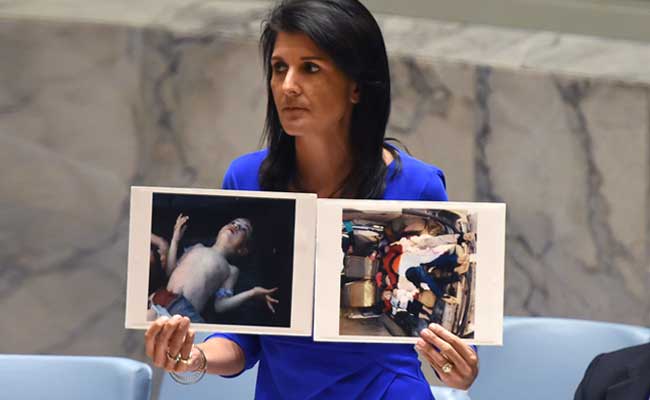
Horrible' Photographs Of Suffering Moved Donald Trump To Action On Syria

'Horrible' Photographs Of Suffering Moved Donald Trump To Action On Syria

When President Donald Trump began receiving his intelligence briefings in January, his team made a request: The president, they said, was a visual and auditory learner. Would the briefers please cut down on the number of words in the daily briefing book and instead use more graphics and pictures?

Similarly, after Trump entered office, his staff took President Barack Obama's Syria contingency plans and broke the intelligence down into more-digestible bites, complete with photos, according to current and former U.S. officials with knowledge of the request.

This week, it was the images - gruesome photos of a chemical weapons attack on Syrian civilians - that moved Trump, pushing the president, who ran on an "America first" platform of nonintervention, to authorize the launch of 59 Tomahawk cruise missiles at Syrian targets Thursday night.

Senior administration officials and members of Congress who spoke with Trump said the president was especially struck by two images: young, listless children being splashed with water in a frantic attempt to cleanse them of the nerve agent; and an anguished father holding his twin babies, swathed in soft white fabric, poisoned to death.

As the carnage unfolded on cable news, which the president watches throughout the day and deep into the night, Trump turned to his senior staff, talking about how "horrible" and "awful" the footage out of Syria was, said one top adviser.

"What the world saw last night was the United States commander in chief, and also a father and grandfather," Kellyanne Conway, counselor to the president, said Friday. "The world recoiled in horror at babies writhing and struggling to live. And who could avert their gaze - and that includes our very tough, very resolute, very decisive president."

Horrific images were not the only reason military action made sense for Trump. Whatever his concern for the people of Syria - a country whose refugees would not be able to enter the United States for 120 days under Trump's latest travel ban proposal - he has been eager to show a clear victory more than two months into his tumultuous young presidency.

A strike against Syria could help him demonstrate independence from Russia and its president, Vladimir Putin, whose alleged efforts to interfere in the 2016 presidential race have proved a major distraction. And Trump wants to show that he is a tougher and stronger leader than Obama, who received scathing criticism when he drew a "red line" with Syria over its use of chemical weapons and then declined to act when President Bashar Assad bounded over it.

Sen. Chris Murphy, D-Conn., on Friday questioned Trump's "24-hour pivot on Syria policy," noting that until Assad's regime launched its chemical attack, Trump had not made Syria a priority. White House press secretary Sean Spicer had told reporters last week that the United States had to accept the "political reality" of Assad's grip on power.

"There is no strategy on Syria," Murphy said. "He clearly made this decision based off an emotional reaction to the images on TV, and it should worry everyone about the quixotic nature of this administration's foreign policy and their potential disdain for the warmaking authority of the United States Congress."

Throughout the week, Trump's public remarks placed a special emphasis on the youngest victims. "When you kill innocent children, innocent babies, babies, little babies, with a chemical gas that is so lethal - people were shocked to hear what gas it was," Trump said Wednesday afternoon in the Rose Garden, where he appeared at a news conference with King Abdullah II of Jordan. "That crosses many, many lines, beyond a red line - many, many lines."

On Thursday, when a subdued Trump addressed the nation, he spoke of "beautiful babies" cruelly murdered, declaring, "No child of God should ever suffer such horror."

About 54 hours after receiving news of the attacks in his daily briefing Tuesday morning, Trump - by then at his private Mar-a-Lago estate in Florida for a summit with Chinese President Xi Jinping - gave the order to target Shayrat air base.

At 7:40 p.m. Thursday, as Trump and Xi were midway through a meal of pan-seared Dover sole with champagne sauce and dry-aged prime New York strip steak (a Trump favorite), a naval destroyer launched the first of nearly five dozen Tomahawk cruise missiles, lighting up the sky in eastern Syria.

White House aides and Trump deputies said that while the photos clearly affected Trump, he made his final decision after consulting with his advisers in a process they described as deliberative and thorough.

Over an intensive 2 1/2 days, the president's national security team convened several high-level meetings with representatives from the Pentagon, the State Department, intelligence agencies and the National Security Council.

"I don't think it was an emotional reaction at all," said Secretary of State Rex Tillerson, who was involved in the discussions. "President Trump evaluated the facts, that the attacks occurred on his watch, and [as he] reflected upon prior responses or lack of responses, he came to the conclusion that we cannot yet again turn away, turn a blind eye from what's happened."

But the process was especially - and perhaps intentionally - quick, in contrast to the style of Obama, who prided himself on making decisions based on information, not emotions, a manner his critics derided as "dithering," as former vice president Richard Cheney put it early in Obama's first term.


Trump learned of the chemical attack Tuesday morning, asked for options on how to respond Wednesday and received them Thursday, the day he authorized the strike.

He asked the Defense Department to prepare potential responses after the Pentagon assessed that the Syrian military was responsible for Tuesday's chemical strike and for chemical attacks March 25 and March 30 against civilians near Hama air base, U.S. military officials said.

U.S. Central Command has had plans for striking the Syrian government for years and has significant assets in the region, enabling a quick response once a decision was made.

The National Security Council deliberated Wednesday night, and Defense Secretary Jim Mattis and other senior officials discussed the possibilities, senior military officials said. Ultimately, aides presented Trump with three options, but the president narrowed them to two and asked aides to flesh out more details.

Senior military and White House officials said Trump selected the "proportional" choice among the options available.

Richard Fontaine, president of the Center for a New American Security, where Mattis was recently a member of the board, said the options probably included doing nothing and launching more comprehensive airstrikes involving bombers and jets.

"I suspect that they said if you are going to do something, they need to do it quickly," Fontaine said. "You need to not hand-wring about this for weeks."

Thursday, Trump held another meeting aboard Air Force One as he flew to Palm Beach, Fla. Some officials - including national security adviser H.R. McMaster, Treasury Secretary Steven Mnuchin, Commerce Secretary Wilbur Ross, Chief of Staff Reince Priebus and senior adviser Stephen Bannon - joined him in the plane's wood-paneled conference room, with others piped in via secure videoconference from Washington as the presidential jet streaked southward.

Once on the ground in Florida, aides said, Trump gave Mattis the order to move forward. The defense secretary passed it along to Marine Gen. Joseph Dunford Jr., chairman of the Joint Chiefs of Staff, and Army Gen. Joseph Votel, chief of U.S. Central Command.

The missiles were launched about three hours later, at 3:40 a.m. local time, to minimize civilian casualties.

In the process, the president - who had championed an "America first" worldview rooted in the belief that U.S. foreign policy had become too interventionist - appeared to swing sharply in the other direction.

Thursday's strike also raised several uncomfortable, still-unanswered questions: Was Trump motivated to attack Syria in part because Obama never did? Was he driven by a need for a political victory, at home and abroad? And what is the administration's long-term strategy and goal in Syria?

It was unclear as well whether Trump fully considered the ramifications of his decision. Russia, whose president has supported Assad and whose troops operate inside Syria, reacted initially with pique, canceling a key air agreement designed to avoid military confrontations with U.S. forces in the skies, before later agreeing to restore the deal.

And even as the White House touted support for the decision in Congress and foreign capitals, administration officials acknowledged that the attack, which they described as commensurate with Assad's violation of "international norms," would not eliminate his ability to do it again.

Though Trump had often seemed to blame Obama for the situation in Syria, his remarks Thursday night from Mar-a-Lago were nonpartisan and intentionally so, a senior adviser said.

The president, this adviser added, was sending a message not only to Syria and Russia but also to China, whose president was in Palm Beach for their summit, and to North Korea that Trump and the United States will not "shirk or shrink" from conflict.

On Friday, Spicer, the press secretary, initially told reporters at Mar-a-Lago that he would offer an update on Syria in front of the news cameras. But just before he was to begin his briefing, he reversed himself: He wanted images of the president, both from the night before on Syria and the China summit Friday, to carry the day.

Ever Wonder What Donald Trump Doesn’t Tell You About His Kids


In 1990, Donald Trump said in an interview with Playboy that “statistically… children of successful people are generally very, very troubled…”

So, does that mean his own children ended up in the same fashion? Although they’ve kept their composure in the spotlight, there’s more going on ‘behind the scenes’ than you’d think. Obviously, no family is perfect. But with five kids, two divorces, and billions of dollars in expandable income, Donald Trump may keeping a few details secret about his precious children

Friday, 24 February 2017

'I just did what was right to do,' says American who stood up for the two Indians

Twenty-four-year-old Ian Grillot, who stood up for Srinivas Kuchibhotla and Alok Madasani, when they were racially abused by Adam Purinton has said he did what was right to do. He was injured in the shooting that followed, which killed Kuchibhotla.

Bartender Garret Bohnen told the Kansas City Star that Kuchibhotla and Mr. Madasani stopped at Austins for a drink once or twice a week.
“From what I understand when he was throwing racial slurs at the two gentlemen [Kuchibhotla and Madasani], Ian [Grillot] stood up for them,” Mr. Bohnen said. “We’re all proud of him.”

Witnesses told The Star that Purinton, 51, yelled “get out of my country” before opening fire.

Mr. Grillot said in an interview from his hospital bed that when the shooting broke out, he hid until nine shots were fired and he thought the suspect’s gun magazine was empty.

“I got up and proceeded to chase him down, try to subdue him,” Mr. Grillot said in a video from the University of Kansas Health System posted on The Star website. “I got behind him and he turned around and fired a round at me.”
Mr. Grillot said the bullet went through his hand and into his chest, just missing a major artery.

“It’s not about where he [victim] was from or his ethnicity,” Mr. Grillot said. “We’re all humans, so I just did what was right to do.”

U.S. Senator Jerry Moran of Kansas posted a statement on Facebook, saying he was very disturbed by the shooting. “I strongly condemn violence of any kind, especially if it is motivated by prejudice and xenophobia,” he said.
Brian Eric Ford, 39, set up the account on GoFundMe, jointly for the family of Kuchibhotla and Mr. Madasani.

“I’ve been pretty closely following the rise in white nationalism since the election,” the Kansas City graphic artist told The Star. “I thought this was a chance to do something to show support for these communities that are being attacked.”

As of Thursday night, 816 people had contributed $29,726 to the fund, which has a target of $50,000.                    

Sunday, 12 February 2017

North Korea test-fires missile, Abe condemns

PYONGYANG: North Korea appeared to fire a ballistic missile early Sunday in what would be its first such test of the year and an implicit challenge to US President Donald Trump, who stood with the Japanese leader as Shinzo Abe called the move 'intolerable.'
There was no immediate confirmation from the North, which had recently warned it was ready to test its first intercontinental ballistic missile. The US Strategic Command said it detected and tracked what it assessed to be a medium- or intermediate-range ballistic missile.
North Korean media are often slow to announce such launches, if they announce them at all. As of Sunday afternoon, there had been no official announcement and most North Koreans went about their day with no inkling that the launch was major international news.
The reports of the launch came as Trump was hosting Prime Minister Abe and just days before the North is to mark the birthday of leader Kim Jong Un's late father, Kim Jong Il.
Appearing with Trump at a news conference at the president's south Florida estate, Abe condemned the missile launch as 'absolutely intolerable.'
Abe read a brief statement in which he called on the North to comply fully with relevant U.N. Security Council resolutions. He said Trump had assured him of US support and that Trump's presence showed the president's determination and commitment.
Trump followed Abe with even fewer words, saying in part: "I just want everybody to understand and fully know that the United States of America stands behind Japan, its great ally, 100 percent."
South Korea's joint chiefs of staff said in a statement that the missile was fired from around Banghyon, North Pyongan Province, which is where South Korean officials have said the North test-launched its powerful mid-range Musudan missile on Oct. 15 and 20.
The military in Seoul said that the missile flew about 500 kilometers. But South Korea's Yonhap news agency reported that while determinations were still being made, it was not believed to be an intercontinental ballistic missile.
The missile splashed down into the sea between the Korean Peninsula and Japan, according to the US Strategic Command. Japanese chief cabinet secretary Yoshihide Suga told reporters that the missile did not hit Japanese territorial seas.
The North conducted two nuclear tests and a slew of rocket launches last year in continued efforts to expand its nuclear weapons and missile programs. Kim Jong Un said in his New Year's address that the country had reached the final stages of readiness to test an ICBM, which would be a major step forward in its efforts to build a credible nuclear threat to the United States.
Though Pyongyang has been relatively quiet about the transfer of power to the Trump administration, its state media has repeatedly called for Washington to abandon its 'hostile policy' and vowed to continue its nuclear and missile development programs until the US changes its diplomatic approach.
Just days ago, it also reaffirmed its plan to conduct more space launches, which it staunchly defends but which have been criticized because they involve dual-use technology that can be transferred to improve missiles.
Kim Dong-yeop, an analyst at the Institute for Far Eastern Studies in Seoul, speculated that the missile could be a Musudan or a similar rocket designed to test engines for an intercontinental ballistic missile that could hit the US mainland. Analysts are divided, however, over how close the North is to having a reliable long-range rocket that could be coupled with a nuclear warhead capable of striking US targets.
South Korean Prime Minister Hwang Kyo-ahn, who is also the acting president, said his country would punish North Korea for the missile launch. According to the Foreign Ministry, South Korea will continue to work with allies, including the United States, Japan and the European Union, to ensure a thorough implementation of sanctions against the North and make the country realize that it will 'never be able to survive' without discarding all of its nuclear and missile programs.

Friday, 3 February 2017

Donald Trump says conversation with Malcolm Turnbull was 'very civil

US President Donald Trump says his conversation with Malcolm Turnbull was "very civil", after news of an adversarial phone call between the allies hit headlines around the world.

On Thursday, the Washington Post broke news of the tense call, with White House sources saying Mr Trump labelled a refugee deal between the US and Australia "the worst deal ever".
He also complained the call was "the worst by far" of any world leader that day, before abruptly ending the conversation 25 minutes into the scheduled hour, sources said.

This account was confirmed to Fairfax Media by an Australian cabinet minister, who described the report as being "broadly accurate".
Speaking on radio on Thursday, Mr Turnbull would only deny he had been hung up on. He said the call, which he described as "frank" and "forthright", ended courteously.

Late on Friday evening, Donald Trump responded to thank him for his comments.
"Thank you to Prime Minister of Australia for telling the truth about our very civil conversation," Mr Trump said.
Mr Trump accused "fake news media" of lying about the phone call.

However, Mr Turnbull did not publicly denounce the report, and government sources told journalists in Australia it was true.

Further government sources briefed numerous journalists on Thursday to say Malcolm Turnbull held his own in the phone call, which they characterized as being bullying.

At a prayer breakfast on Thursday, Trump also appeared to acknowledge he had been having "tough" phone calls.

"When you hear about the tough phone calls I'm having, don't worry about it," Mr Trump said. "Just don't worry about it. They're tough. We have to be tough.

"It's time we're going to be a little tough folks. We're taken advantage of by every nation in the world virtually. It's not going to happen anymore. It's not going to happen anymore."

Later, as diplomats in the US and Australia scrambled, Mr Trump held a meeting at the White House where he sent more mixed messages, implying Australia had taken advantage of the United States.

"A lot of people taking advantage of us, a lot of countries taking advantage of us, really terribly taking advantage of us," he said.

"We had one instance in Australia - I have a lot of respect for Australia, I love Australia as a country - but we had a problem where, for whatever reason, President Obama said that they were going to take probably well over a thousand illegal immigrants who were in prisons," he said.

"They were going to bring them and take them into this country. And I just said why?

"Why are we doing this? What's the purpose? So we'll see what happens. But a previous administration does something, you have to respect that."

Mr Turnbull has maintained the refugee deal - which will see 1250 refugees from Manus Island and Nauru taken to the US - will go ahead.

François Hollande leads attacks on Donald Trump at EU summit

François Holland has led a series of damning attacks on Donald Trump by EU leaders arriving at a summit in Malta to discuss the future of the union.

The French president described recent comments by the US president as unacceptable and warned there would be no future for Europe’s relations with the US “if this future isn’t defined in common”.

The Austrian chancellor, Christian Kern, said Trump’s ban on travelers from some Muslim-majority countries was “highly problematic”.

Dalia Grybauskaitė, the Lithuanian president, offered a withering verdict on the recent meeting between Trump and Theresa May. “I don’t think there is a necessity for a bridge. We communicate with the Americans on Twitter,” she said.
The British prime minister, with the UK’s recently appointed permanent representative to the EU, Sir Tim Barrow, by her side, was one of the few leaders not to comment as she entered through the door of the Grand Masters Palace, where the 28 member states are holding talks.

Holland was scornful of Trump’s first days in the Oval office, and warned him to stay out of the EU’s internal affairs. “It cannot be accepted that there is, through a certain number of statements by the president of the United States, pressure on what Europe ought to be or what it should not be,” he said.

On Thursday the Guardian revealed that leaders of the parties in the European parliament were seeking to block the expected appointment of Ted Malloch as the US ambassador to the EU following his claim that he intended to “tame” the union.

Asked what he thought of EU leaders, like those of Hungary and Poland, who were leaning towards Trump, Holland said: “Those who want to forge bilateral ties with the US are of course well understood by the public.

“But they must understand that there is no future with Trump if it is not a common position. What matters is solidarity at the EU level. We must not imagine some sort of external protection. It exists through the Atlantic alliance, but it cannot be the only possible route, because who knows what the US president really wants, particularly in relation to the Atlantic alliance and burden-sharing?

“We in France have a defense policy. We fear nothing … We must have a European conception of our future. If not, there will be – in my opinion – no Europe and not necessarily any way for each of the countries to be able to exert an influence in the world.”

The European commission president, Jean-Claude Juncker, said he did not feel “threatened” by Trump, but voiced his concern that the US administration was not on top of world affairs. “There is room for explanations because of the impression that the new administration does not know the EU in detail, but in the European Union details matter,” he said.
Austria’s leader, Kern, said of Trump’s decision to ban nationals from seven Muslim-majority countries: “We should win these countries as allies in the fight against [radical] Islamism, not as adversaries, and we shouldn’t corner them.”

He went on to highlight what he described as America’s “responsibility for the refugee flows through the way it intervened militarily”.

Kern said: “It’s not acceptable for the international community if America shirks responsibility. We need to make this clear to our American friends. I’m convinced that there will be a high degree of unanimity [among EU leaders] on this question … The tangible aspects of Trump’s politics are raising some concern.” He added that Trump could be a catalyst for a stronger Europe.

Xavier Bettel, Luxembourg’s PM, said it was too soon to draw conclusions on Trump but his were “not the values I’m fighting for in politics”.

The European commission’s high representative, Federica Mogherini, said the EU did not “believe in walls and in bans”, and claimed the union would be a reference point for the world. She said: “We are and we will remain friends with the American people and the American administration on the basis of our own strong values, principles and interests.”

The European commissioner Günther Oettinger warned the EU not to allow Trump to divide them. “First of all, we must be careful not to accept his game,” Oettinger, a German, told Deutschlandfunk radio.

Sunday, 29 January 2017

Donald Trump defends ban on immigrants from Muslim countries

US President Donald Trump on Sunday defended his decision to issue executive orders temporarily barring refugees from seven Muslim-majority countries entering the US, by describing the world as being in 'a horrible mess.'
Facing severe criticism for his decision - both within the US as well as elsewhere - Trump took to Twitter once again to justify barring refugees from Iraq, Iran, Sudan, Libya, Somalia and Yemen for a period of 120 days. The ban on refugees from Syria is indefinite.
"Our country needs strong borders and extreme vetting," he wrote on his Twitter handle, adding that the world is in a horrible mess.
The move to bar refugees from Muslim-majority countries has been slammed by political leaders, economists, social workers and even entrepreneurs like Facebook's Mark Zuckerberg+ and Google's Sundar Pichai+ . In the UK, while PM Theresa May said the decision is a matter of the US government, the decision will not be replicated in her country.
"We do not agree with this kind of approach and it is not one we will be taking," she said.
Jeremy Corbyn, leader of opposition in the British Parliament, went several steps further by demanding that Trump be banned from UK till he lifts the ban on immigrants.
Germany too took a hard view of the decision. A spokesman for Chancellor Angela Merkel says the German leader believes the Trump administration's travel ban on people from some Muslim-majority countries is wrong.
Within the US, voices opposing the move steadily increased. The University of Michigan on Saturday defied the executive order and refused to release the immigration status+ information of its international students.
On his part, Trump is expected to speak to King Salman of Saudi Arabia and Sheikh Mohammed bin Zayed Al Nahyan, the crown prince of the United Arab Emirates capital of Abu Dhabi on the matter. Saudi Arabia and UAE are, however, not among the countries mentioned in the ban.
Stay updated on the go with Times of India News App. Click here to download it for your device.

Sunday, 24 April 2016

Trump mocks Indian call centres

STANDING WITH TRUMP: Supporters at a Trump rally in Harrington, Delaware.

Republican presidential frontrunner Donald Trump used a fake accent to mock a call centre representative in India.

At the same time, he described India as a great place. The billionaire from New York said he called up his credit card company to find out whether their customer support is based in the U.S. or overseas.

“Guess what, you’re talking to a person from India. How the hell does that work?” he told his supporters in Delaware. “So I called up, under the guise I’m checking on my card, I said, ‘Where are you from?’” Mr. Trump said and then he copied the response from the call centre in a fake Indian accent. “We are from India,” Mr. Trump impersonated the response.

Fake accent

“Oh great, that’s wonderful,” he said as he pretended to hang up the phone.

“India is great place. I am not upset with other leaders. I am upset with our leaders for being so stupid,” he said. “I am not angry with China. I am not angry at Japan. I am not angry with Vietnam, India...all these countries.”

Mr. Trump mentioned the fake call to India during his remarks on what he described as “crooked banking”.

Delaware is a hub for America’s banking and credit card industry. The list includes Bank of America, Citibank Delaware, M&T Bank and PNC Financial Services Group.

“They are making a lot of money,” he said. “You can’t allow policies that allow China, Mexico, Japan, Vietnam, India. You can’t allow policies that allow business to be ripped out of the United States like candy from a baby.”

“The manufacturing jobs are being stolen. Our jobs are being taken. We are losing at every front. There is nothing good. Our country does not win anymore. The jobs are being stripped. Factories are closing. We are not going to let this happen anymore,” he said.

Mr. Trump added he has as many as 378 companies registered in Delaware, where the Republican presidential primary is scheduled on April 26 along with several other states. He is leading in polls against his other primary rivals.

In his speech, Mr. Trump praised Delaware’s status as a tax shelter and slammed President Barack Obama for not using the term “radical Islamists” in the fight against terrorism. “I want to run against crooked Hillary,” he said.

Indian workers worst to understand, says Maine’s Republican Governor

This photo tweeted by @mainegop, the official handle of the the Maine Republican Party, shows the State’s Governor Paul LePage speaking at the party convention on Saturday.

Indian workers are the “worst” and the “hardest” ones to understand, Republican Governor of U.S. State of Maine Paul LePage said, stirring another controversy by his party members in this election cycle.

In his address to the Maine Republican convention, where the party selected its delegates for the July national convention, Mr. Page alleged that foreign workers are being used in local restaurants.
Mr. LePage said workers from India are “hardest” and “the worst ones” to understand and one has to get an interpreter to talk to an Indian. However, he then quickly described Indians as “lovely” people.

Mr. LaPage’s remarks came a day after Donald Trump mocked Indian call centres but described India as a “great place“.

However, both Mr. LePage and Mr. Trump suffered a setback at the Maine Convention, which elected 19 of the 23 delegates who are Ted Cruz supporters.

Maine is a small northeastern State in the U.S.

In his speech, Mr. LePage was highly critical of Mr. Cruz, accusing him of “stabbing us in the back”.

“We reached a deal with Cruz’s national campaign to put up a unity slate that would honour the wishes of the thousands of Mainers who voted at caucus. But Cruz’s Northeast Political Director David Sawyer lied to us and broke the deal. Sawyer stabbed us in the back, reneged on the unity slate and betrayed the people of Maine,” he said in a statement.

Meanwhile, Mr. Cruz notched up more delegates than Mr. Trump on Saturday. He won at least 65 of the 94 delegates up for grabs over the weekend.

As of Saturday, Mr. Trump had 845 delegates against 559 of Mr. Cruz.

A candidate needs to have at least 1,237 delegates to earn the Republican presidential nomination.

Primaries are still to be held in 15 States, with the next round of primaries to be held in Maryland, Delaware, Philadelphia, Rhode Island and Connecticut on Tuesday.

Polls show that Mr. Trump is leading in all these States.

Monday, 14 March 2016

Trump and the violence of the angry American

Donald Trump. File photo.

It has been a long time coming, but the past week witnessed the election campaign of Donald Trump, the property mogul who has baffled pundits to emerge as the surprise frontrunner in the Republican Party nomination, descend into a vortex of violence against protestors and the media, to the point where the candidate had no choice but to cancel a major rally in Chicago.

Those watching Mr. Trump’s campaign closely know that the wave of intolerance that it has generated has for months now been laced with a snarling undertone of aggression towards critical opinion in general, and this was focussed on the media until recently.

Speaking of political journalists earlier on in his bid to win the GOP nomination Mr. Trump said, “I do hate them... Some of them are such lying, disgusting people. … [They’re] among the most dishonest groups of people I’ve ever met.”

In the past week the media continued to face his wrath even though he has arguably been biggest beneficiary of news media coverage of the Republican presidential campaign.

Last Tuesday, Michelle Fields, reporter with the conservative Breitbart website that is friendly towards Mr. Trump, said that her arm was violently pulled by Trump campaign manager Corey Lewandowski as she was trying to ask Mr. Trump a question.

Although Mr. Trump’s campaign denied the accusation Ms. Fields tweeted a photograph of the bruise on her arm and this week she and one of her colleagues resigned from Breitbart, saying the site should be “ashamed” of the way Ms. Fields was treated.

One week before this a photographer for Time Magazine was subjected to a chokehold by a Secret Service agent in Virginia after he stepped outside a press area to photograph protesters.

While Mr. Trump made no bones of his distaste for the media, increasingly he has turned his ire upon protestors at his swelling rallies, reprising his famous “You’re fired!” punch-line from The Apprentice, the U.S. reality game show that he created, with “Get ‘em out of here!” which was a signal for Secret Service agents to eject protestors from his rallies.

That somewhat jarring but relatively contained spectacle has acquired a menacing edge in the past few months after Mr. Trump has apparently started encouraging his supporters at rallies to hit back.

In early February in Iowa Mr. Trump said, “If you see somebody getting ready to throw a tomato, knock the [expletive] out of them, would you? Seriously. Okay?... I promise you I will pay for the legal fees.”

During a rally in Las Vegas last month he said about protestors, “You know what they used to do to guys like that when they were in a place like this? They’d be carried out in a stretcher, folks... I’d like to punch him in the face, I tell ya.”

Earlier this month he said during a rally in Warren, Michigan, “Get him out! Try not to hurt him. If you do, I’ll defend you in court.”

In the past week he has reprised his promise to pay the legal fees of a man who was arrested after throwing a face-punch at an unsuspecting Black Lives Matter protester at a rally in North Carolina, an attack that was captured on multiple videos and went viral on social media.

“The man got carried away,” Mr. Trump said in media interviews after the assault, adding, “He obviously loves his country, and maybe he doesn’t like seeing what’s happening to the country.”

Perhaps bristling at having to cancel his Chicago rally because he didn't “want to see people hurt or worse” at the venue Mr. Trump attempted to blame Vermont Senator and Democratic Party underdog Bernie Sanders for the protestors.

While both Mr. Sanders and Democratic nomination frontrunner Hillary Clinton blasted Mr. Trump for fuelling violence amidst his supporters, with Mr. Sanders calling Mr. Trump a “pathological liar,” even Mr. Trump’s Republican rivals such as Texas Senator Ted Cruz have come out saying Mr. Trump has created a toxic environment at rallies with a campaign that “affirmatively encourages violence.”

If, at the heart of Mr. Trump’s rhetoric, which is regularly compared to the politics of Nazi Germany, there is a coherent philosophy, it may well rest upon Mr. Trump’s constant allusion to the U.S. having become a “weak” and “scared” nation, indeed the reason why his campaign promises to “Make America Great Again.”

Yet many wonder if this notion of an “angry America,” an essentially pejorative assessment of the grand strides made by the Obama administration after the Great Recession, could ever set the tone for a successful Trump presidency, terrifying as that prospect may seem to many Americans.

Assuming Mr. Trump wins the GOP nomination, as he appears well set to do, it will be up to liberal and progressive Americans use their votes wisely if they wish to keep a dangerous combination of nihilism and narcissism out of the Oval Office.

Sunday, 13 March 2016

Trump routed in Wyoming, Washington DC; presidential race tightens

Republican presidential candidate Donald Trump points towards a demonstrator in the audience as he spoke at an election rally in Kansas City, Saturday.

Donald Trump on Sunday suffered a double blow as the controversial Republican front-runner was routed by rivals Ted Cruz and Marco Rubio in polls in the U.S. capital and Wyoming, signalling that the fight for securing the party’s nomination was hotting up ahead of crucial primaries on Tuesday.

Seeking to put a break to Mr. Trump’s momentum in the race for the White House, Republican presidential candidates Senators Cruz and Rubio scored victories in the party’s caucuses in Wyoming and District of Columbia respectively.

While Mr. Cruz added nine delegates to his kitty, Mr. Rubio had 10 more as they now set their sights on the crucial Republican party’s presidential primaries in the key states of Florida, Ohio, Illinois, Missouri and North Carolina on March 15.

Mr. Trump, the 69-year-old real estate tycoon, is said to be the favourite at this point of time as he has the maximum number of 460 delegates followed by Cruz (367), Rubio (153) and the Ohio Governor John Kasich 63.

To win the party’s presidential nominee, the candidates need to have the support of 1,237 delegates out of a total of 2,472 delegates.

In the Republican caucus in the U.S. capital, Rubio earned 37.3 per cent of the vote against 35.5 per cent for Ohio Governor John Kasich. Mr. Trump was third, with 13.8 per cent support. Mr. Rubio defeated Mr. Kasich by just 50 votes.

Two weeks ago, Mr. Trump won a straw poll conducted by the Republican party, followed by Mr.Rubio, Mr. Cruz, Mr. Kasich and retired neurosurgeon Ben Carson, who has since dropped out of the race.

Mr. Rubio has so far won Minnesota, Puerto Rico and District of Columbia.

However, he has put all at stake in his home state of Florida where the primary is scheduled for March 15. It would be very difficult for him to continue his presidential ambition with a loss in Florida.

The same is true for Mr. Kasich, who is fighting a battle for survival in the race in Ohio.

Mr. Cruz is the only Republican candidate to have defeated Mr. Trump in more than half a dozen states.

He handsomely defeated Mr. Trump in Wyoming. Mr. Cruz won nearly two-thirds of the total vote in Wyoming Caucuses.

Mr. Cruz crushed Mr.Trump by winning 66.3 per cent of the ballots, far ahead of Mr. Rubio, his nearest rival, who earned 19.5 per cent of the vote. Mr. Trump came in third with a measly 7.2 per cent.

On the Democratic side, Former Secretary of State and front-runner Hillary Clinton won in the first ever Democratic Party caucus on the Northern Mariana Islands, a US possession deep in the Pacific Ocean. She won four delegates, while her rival, Vermont Senator Bernie Sanders, won two.

Mr. Cruz also picked up one delegate in Guam while the island’s five other delegates were uncommitted.

Sunday, 28 February 2016

Republicans’ frantic efforts to derail Donald Trump fall flat

Donald Trump

The scenario Karl Rove outlined was bleak.

Addressing a luncheon of Republican governors and donors in Washington on February 19, he warned that Donald Trump’s increasingly likely nomination would be catastrophic, dooming the party in November. But Rove, the master strategist of George W. Bush’s campaigns, insisted it was not too late for them to stop Mr. Trump, according to three people present.

At a meeting of Republican Governors the next morning, Paul R. LePage of Maine called for action. Seated at a long boardroom table at the Willard Hotel, he erupted in frustration over the state of the 2016 race, saying Mr. Trump’s nomination would deeply wound the Republican Party.

Mr. LePage urged the Governors to draft an open letter “to the people,” disavowing Mr. Trump and his divisive brand of politics.

The suggestion was not taken up. Since then, Mr. Trump has only gotten stronger, winning two more State contests and collecting the endorsement of Gov. Chris Christie of New Jersey. In public, there were calls for the party to unite behind a single candidate. In dozens of interviews, elected officials, political strategists and donors described a frantic, last-ditch campaign to block Mr. Trump — and the agonising reasons that many of them have become convinced it will fail. Behind the scenes, a desperate mission to save the party sputtered and stalled at every turn.

On Friday, a few hours after Mr. Christie endorsed him, Mr. Trump collected support from a second Governor, who said Mr. Trump could be “one of the greatest presidents.” That Governor was Paul LePage.

Wednesday, 17 February 2016

Obama believes Trump will not be President

U.S. President Barack Obama

U.S. President Barack Obama believes Republican White House hopeful Donald Trump would not be elected as his successor as being a President is tougher than hosting a reality show and Americans are too “sensible” to elect him.

“I continue to believe Mr Trump will not be President. And the reason is because I have a lot of faith in the American people, and I think they recognise that being President is a serious job,” Mr. Obama told reporters after the first ever US-ASEAN Summit in Sunnylands, California. “It’s not hosting a talk show or a reality show. It’s not promotion. It’s not marketing,” he said.

The 69-year-old billionaire real estate tycoon fired back, saying Mr. Obama was lucky that he did not run for office in 2012. “You’re lucky I didn’t run last time when Romney ran because you would have been a one-term president,” Mr. Trump said at a campaign rally in South Carolina. Mr. Obama also criticised other Republican candidates.

He said he thinks foreign observers are troubled by some of the rhetoric that’s been taking place in these Republican primaries and Republican debates. “I don’t think it’s restricted, by the way, to Mr. Trump. I find it interesting that everybody is focused on Trump, primarily just because he says in more interesting ways what the other candidates are saying, as well,” he noted. “He may up the ante in anti-Muslim sentiment, but if you look at what the other Republican candidates have said, that’s pretty troubling, too,” Mr. Obama said.

The President said Mr. Trump was not the only Republican who raised concerns, but he singled out the real estate mogul as someone who would be singularly unprepared for the responsibilities of the Oval Office.

In an apparent reference to another Republican presidential aspirant Marco Rubio, the Senator from Florida, Mr. Obama said there is a candidate who sponsored a bill, which he supported, to finally solve the immigration problem, and he’s running away from it as fast as he can.

Observing that all Republican candidates are denying climate change, Mr. Obama said he this that’s troubling to the international community, since the science is unequivocal.

Other countries around the world, they kind of count on the United States being on the side of science and reason and common sense, because they know that if the U.S. does not act on big problems in smart ways, nobody will, Mr. Obama said.

“But this is not just Mr. Trump. Look at the statements that are being made by the other candidates. There is not a single candidate in the Republican primary that thinks we should do anything about climate change; that thinks it’s serious. Well, that’s a problem,” said the U.S. President.

Being in the office, he said, is not a matter of pandering and doing whatever will get one in the news on a given day. “Sometimes it requires you making hard decisions even when people don’t like it, and doing things that are unpopular, and standing up for people who are vulnerable but don’t have some powerful political constituency,” he said.

However, Mr. Trump continued to lead in the Republican polls in South Carolina, where the primary is scheduled for Saturday.

In an American Research Group (ARG) poll conducted this week, Mr. Trump was leading by 33 per cent followed by Mr. Rubio at 16 per cent. CNN/ORC in its polls said Mr. Trump had support of 38 per cent, while Ted Cruz was at the second spot with 16 points. In South Carolina, Mr. Trump was highly critical of Mr. Obama’s record in office.

Mr. Trump claimed Mr. Obama has done a “lousy” job on spending, national defence, healthcare and immigration. “You look at our budgets, our spending, we can’t beat ISIS, Obamacare is terrible — we’re going to terminate it — absolutely terminate and replace it,” he said.

“You look at everything. Our borders are like Swiss cheese. This man has done such a horrible job, he’s set us back so far. For him to say that is actually a great compliment, if you want to know the truth,” Mr. Trump said.

Tuesday, 16 February 2016

Trump threatens to sue Cruz unless his rival apologises

Republican U.S. presidential candidate Senator Ted Cruz (L) listens as businessman Donald Trump speaks at the Republican U.S. presidential candidates debate

Republican presidential candidate Donald Trump has offered rival Ted Cruz an ultimatum, threatening to sue Cruz over his eligibility to serve in the White House unless the Texas senator stops airing what Trump calls “false ads” and apologises for what the billionaire real estate mogul called a series of lies about his positions.

With less than a week to go before South Carolina’s pivotal Republican primary, the front-runner also reiterated that the 9/11 attacks happened during President George W. Bush’s time in office an apparent attempt to overshadow the former president's Monday campaign appearances on behalf of his brother, former Florida Gov. Jeb Bush.

The new attacks came as the race entered an increasingly nasty phase, with numerous negative ads airing on local television following an unusually caustic debate this past weekend.

Some of the harshest ads have been aimed at Trump, often using the political newcomer’s past words to illustrate his evolving position on issues including abortion and gun rights.

Trump also took aim yesterday at the Republican establishment, accusing the Republican National Committee of packing its debate audiences with donors a move he claimed violated the loyalty pledge he signed in September vowing to run as a Republican and support the party’s eventual nominee.

“I signed a pledge, but it’s a double-edged pledge,” Trump said at a luncheon in Mount Pleasant, South Carolina. “The pledge isn’t being honored by the RNC.”

But Trump saved the bulk of his criticism for Cruz. “If he doesn’t take down his false ads and retract his lies,” Trump said in a statement bashing Cruz, he will immediately file a lawsuit challenging Cruz’s eligibility to serve as President.

Trump has previously said a federal court should decide whether Cruz meets the constitutional requirement of being a “natural-born citizen” to serve as President. Cruz was born in Canada to an American mother, and many legal experts have said he meets that test.

“Ted Cruz is a totally unstable individual. He is the single biggest liar I’ve ever come across, in politics or otherwise, and I have seen some of the best of them. His statements are totally untrue and completely outrageous,” Trump said in the statement.

George W. Bush walks into Trump fire to rescue Jeb

George W. Bush and Jeb Bush

Former president George W. Bush waded into the murky waters of the Republican nomination contest to rescue the sagging fortunes of his younger brother Jeb Bush on Monday and has himself become the target of an escalating attack from front runner Donald Trump.

The elder Mr. Bush used self-deprecating humour and tales from his presidential years to build a case for the younger one’s candidacy but that may not be sufficient to stop Mr. Trump, who continues with his no holds barred attack on the Bush dynasty, in his tracks. “Excuse me, the World Trade Center came down during the reign of George Bush, right? It came down. That was the greatest attack in the history of the United States — worse than Pearl Harbor.... We weren’t safe,” Mr. Trump said before the Bush brothers appeared together in South Carolina where the Republican primary is scheduled for February 19.

The agile political gambler that he is proving to be, Mr. Trump appears to have pulled off yet another winning strike with his attack on the Bush dynasty that he began during Saturday’s debate. A poll released on Monday shows him at 35 percent, almost as much his two closes rivals, Senators Marco Rubio and Ted Cruz combined. Both the senators are tied at 18 per cent each. Mr. Trump said the elder Mr. Bush lied about Saddam Hussein possessing weapons of mass destruction, and led the U.S to an unnecessary war in Iraq in 2003 that he called a “big fat mistake” — something that no Republican would dare say, and provoking huge boos from the audience.

But Mr. Trump is keeping the heat up. “Now that George Bush is campaigning for Jeb, is he fair game for questions about World Trade Center, Iraq War and eco collapse? Careful!” he tweeted after the debate. “Funny that Jeb didn't want help from his family in his failed campaign and didn't even want to use his last name…Then mommy, now brother!” he tweeted on Monday. Former first lady Barbara Bush is also campaigning for her son.

Risking a nasty appraisal of his presidential legacy within the Republican Party, George W. Bush’s speech for Jeb Bush did not leave anyone one in doubt who the target was, though he did not name Mr. Trump. “I understand that Americans are angry and frustrated but we do not need someone in the Oval Office who mirrors and inflames our anger and frustration,” Mr. Bush said. “We need someone that can fix the problems that cause our anger and frustration, and that's Jeb Bush.”

“In my experience, the strongest person usually isn't the loudest in the room,” the former President said and also defended his decisions following the 9/11 terrorist attacks terming them “tough calls.”

Setting a moderate tone on immigration, he said of Indian-origin Governor of South Carolina Nikki Haley: “Thank goodness our country welcomed her parents from India when they immigrated here in 1969.” Mr. Trump’s campaign, among other things also calls for restricting immigration. Ms. Haley, a Republican, has not endorsed any candidate yet, but has made comments that were widely understood as against Mr. Trump.

Mr. Trump’s fire is not entirely focused on the Bush dynasty, however. Jeb Bush is still in the fifth place in the race and the immediate threat Mr. Trump has to deal with is Mr. Cruz. According to a TV channel, Mr. Trump has called Mr. Cruz “dishonest” or “liar” 55 times over Sunday and Monday.

Sunday, 14 February 2016

Republican presidential hopefuls say destroying ISIS top priority

Republican presidential candidates, from left, Ohio Gov. John Kasich, former Florida Gov. Jeb Bush, Sen. Ted Cruz, R-Texas, businessman Donald Trump, Sen. Marco Rubio, R-Fla., retired neurosurgeon Ben Carson take the stage before the CBS News Republican presidential debate at the Peace Center, Saturday, Feb. 13, 2016, in Greenville, South Carolina.

Top Republican presidential aspirants have agreed that defeating ISIS is one of the top priority for the US even as they sharply differed on the process to combat the terror outfit.

Frontrunner Donald Trump favoured America partnering with Russia to defeat ISIS, while Jeb Bush said a Sunni—led coalition along with special US forces would accomplish the job, and Ted Cruz did not rule out sending troops on the ground along with massive air power to defeat ISIS.

“We are going to have to hit very, very hard to knock out ISIS,” Mr. Trump said participating in the Republican presidential debate in this city in South Carolina, where Indian—American Nikki Haley is the Governor.

He said he would do this with Russia.

“This is the problem,” Mr. Bush, the former Florida Governor said as he opposed the idea of partnering with Russia to defeat ISIS.

“Russia is not taking out ISIS. They’re attacking the team that we’ve been training and the team that we’ve been supporting. It is absolutely ludicrous to suggest that Russia could be a positive partner in this,” he said, claiming that he has the right policy to defeat ISIS.

“I would immediately create a policy of containment as it relates to Iran’s ambitions, and to make it make clear that we are not going to allow for Iran to do what it’s doing, which is to move towards a nuclear weapon,” Mr. Bush said.

“We need to create a coalition, Sunni-led coalition on the ground with our special operators to destroy ISIS, and bring about stability,” said the former Florida Governor who is hoping to be the third from the Bush family to be elected as the US president this fall.

Mr. Cruz said there needs to be a focused objective and a commander-in-chief, when it comes to defeating ISIS.

“We need overwhelming air power, we need to arm the Kurds who can be our boots on the ground, and if ground troops are necessary than we should employ them, but it shouldn’t be politicians demonstrating political toughness. It should be military expert judgement carrying out the objectives set out by the commander—in—chief,” Mr. Cruz said.

Senator Marco Rubio identified the threat posed by North Korea in the Asia—Pacific region as among the top threats to national security, followed by the growing threat of ISIS.

He said: “Violent extremists are operating or active in 40 countries. Some 80 countries are in different degrees of instability. And so, that’s just the crises overseas.”

Former Ohio Governor John Kasich differed with Mr. Trump on seeking Russian help to defeat ISIS.

“We have to make it clear to Russia what we expect. We don’t have to declare an enemy, rattle a sword or threaten, but we need to make it clear what we expect. Number one is we will arm the folks in Ukraine who are fighting for their freedom. They deserve it. There will be no ifs, ands or buts about it,” he asserted.

Friday, 5 February 2016

Among the believers: On the American campaign trail


“Muslims? Is she talking about grandma?” her four-year-old daughter asked Kelda York. “Yes,” Ms. York replied, “Grandma and other Muslims.”

What aroused the child’s curiosity was Democratic presidential aspirant Hillary Clinton’s call to “hold our Muslim friends close to the rest of the society”. Ms. York’s mother had converted to Islam two decades ago. “My mother started reading about Islam when my father went to Iraq as a solider in 1992 and converted,” Ms. York said. She brought both her daughters to Ms. Clinton’s rally. “I want them to grow up proud and confident,” she said.

In defense of diversity
Ms. Clinton is facing an uphill task in New Hampshire that will choose between her and Bernie Sanders, Senator from the neighborliness State of Vermont who commands significant influence in the State. Ms. Clinton was advised by many to skip the contest in New Hampshire altogether and focus on States where her presence is more formidable. “I could not have done that. So I am here,” she told a crowd of around 500 on Wednesday night. Carefully seated in the camera frame, right behind Ms. Clinton, were girls with Islamic scarves, blacks, whites, browns and Latinos; transgender people and women’s activists milled around. “Fighting for us,” their placards said, as they swayed to Rachel Platten’s Fight Song, a 2015 song released as a single that sold two million copies in the U.S. “Can you hear my voice this time?, This is my fight song, Take back my life song, Prove I’m alright song,” the song goes.

But waiting for Ms. Clinton’s arrival earlier in the evening, 20-year-old Miranda Monaghan was holding her placard down. “I have not decided yet,” she said. “I am not so sure she believes in all this,” the undergraduate student said, as Ms. Clinton explained how she and Mr. Sanders were in agreement on reining in the Wall Street and ensuring health care for all. Ms. Monaghan found Mr. Sanders more suitable for the job.

At Ms. Clinton’s rally, hours after Barack Obama made his first visit as President to a U.S. mosque, American diversity was being celebrated. On Tuesday evening, at Republican front runner Donald Trump’s rally some miles away, it was a different atmosphere. Mr. Trump, battered in the Iowa caucuses the previous night, was playing defensive and explaining his second place as a big victory. Ann Coulter, an immensely influential conservative commentator and author, outlined the agenda, speaking before Mr. Trump’s arrival on the stage. If anyone speaks clearer than Mr. Trump this season, it must be Ms. Coulter. Not that Mr. Trump’s philosophy needs explanation.

“Trump announced his candidacy talking about Mexican rapists. We are not supposed to say this, we can talk about American rape culture, but not about Mexicans raping. There is a whole list of politically incorrect things that one is not supposed to say... Donald Trump seems to be going through each one of them… one by one, he is going to use each one of them by the end of this campaign,” Ms. Coulter explained the virtues of her candidate. And she can’t wait to see Mr. Trump in the White House. “Can you imagine that?” she asks, and helps them imagine.

“The director of immigration will come and tell President Trump, ‘we have admitted 1.5 million Muslims since 9/11. Ninety per cent of them go on welfare immediately and some percentage of them kill Americans. Should we keep admitting a million Muslims every ten years?”’

“No… No,” the crowd replies.

“Yes, that is exactly what President Trump will say.”

Director of Immigration comes back again, “Should we keep replacing Americans with Mexicans, Somalis and Pakistanis?’’

“No… No… No.”

By this time, Trump supporters must have been looking for some Mexicans or Muslims inside the venue. “Please don’t react if anyone protests. Those who want to protest may protest outside,” a particularly law-abiding organizer announces before Mr. Trump takes the stage. At a previous rally in New Hampshire, Trump supporters beat up protesters.

“We have a movement. It is a people’s movement,” Mr. Trump declared. He then goes on to talk about the dangers that lurk around — “three people were killed by illegal immigrants” in unspecified places and climate change is a hoax Mr. Obama is playing. In a moment of gender sensitivity, Mr. Trump also points out to a woman who, he says, could be carrying a gun to places such as this gathering to prevent terror attacks. “This man, that man, and yes, we must have a woman too… you here.”

Judie Brown, a 65-year-old lady at the Trump meeting, is worried primarily about the economy and fears that her social security pension may be affected. In a measured tone, she explains the economic stress that the middle class is feeling. Does she agree with what she just heard about Muslims? “I was trying to avoid that topic. You know, I think they are unable to integrate into the society.” Does she support a ban on Muslims entering the country? “I support a ban on immigration altogether. Not only for Muslims,” she said, continuing to measure her words. And she had not finalised her choice in the primary — the other option she is considering is Marco Rubio, Senator from Florida.

As Mr. Trump signs autographs and poses for photographs, Adele can be heard in the background: “You’re gonna wish you never had met me… And I’m gonna make your head burn, Think of me in the depths of your despair….” Playing this Adele song in recent rallies is the latest controversy that Mr. Trump has courted. A spokesperson of the singer has said the candidate is using it without permission.

The rise of Rubio
Ms. Coulter ridiculed Mr. Rubio as the “Cuban kid who likes his high heels” but he is making it tough for Republican front runners Mr. Trump and Texas Senator Ted Cruz. After finishing a close third behind Mr. Trump in Iowa, Mr. Rubio is moving gradually to the center, projecting the image of a ‘compassionate conservative’, and is attracting more and more Republicans towards him. A compassionate conservative is what many others in the fray also want to be seen as — Jeb Bush, John Kasich and to a lesser extent Chris Christie have sought to build the same image. But Mr. Rubio’s advantage is that he is more charismatic and has managed the expectations better than others. He seems increasingly the choice of people such as Ms. Brown, and that indeed that is his pitch at a morning gathering on Thursday.

Mr. Rubio says he favors a compassionate criminal justice system that considers drug addicts as victims rather than criminals; a social security mechanism that will keep the elderly secure. He goes on to explain how, as a teenager, he got involved in a drunken brawl and almost landed in jail. “That would have ended my life. We have people who get caught for minor offences and get sucked into the justice system without any possibility of escape. Poor people, mostly black, are forced to plead guilty because they don’t have money to pay lawyers,” Mr. Rubio’s compassionate agenda in response to convenient questions goes on and on. But Mr. Rubio considers Mr. Obama’s mosque visit a ploy to “divide Americans”. “It gives an impression that Muslims are discriminated against in America. We have to address all these issues without dividing Americans based on gender, race, or class,” he says. He does not mention religious divisions, though his speech had numerous references to his own Christian faith. “Obama wants to change America. I want to restore America,” he says.

A few miles away and two hours later on Thursday, Mr. Cruz’s political speech sounds more like a bad Sunday sermon. Forty-year-old James Mosher, who was at the previous Trump rally too, has a question for Mr. Cruz — why doesn’t he get the support of “good people” such as Ms. Coulter? But still, he declares his support for Mr. Cruz. “Trump wrote a book called The Art of the Deal, it should be called The Art of the Con,” he explains later. “He has married thrice.” “Because of my faith in Jesus,” he cites his reason for supporting Mr. Cruz. Mr. Cruz says he is leading America to a “revolution”. “We are bringing power back to ‘we, the people’.” Revolution for him is a recognition of Judeo-Christian values that he thinks Mr. Obama has undermined.

Oldest man, biggest dreams
But the prospect of a more this-worldly revolution is inspiring the Bernie Sanders’s camp that a merchandise vendor described as a “bunch of broke college kids”. But that is not exactly true. John Baronowski, a 70-year-old man sitting behind Mr. Sanders, is on his feet numerous times through Mr. Sanders’s one-hour speech, just before his debate with Ms. Clinton on Thursday night. “The planet craves for him. Mankind needs him,” Mr. Baronowski says. There are people of all ages — some 500 of them — in the room.

The oldest man in the fray, 74-year-old Sanders is inspiring the biggest dreams. “How many of you have student loans?” Mr. Sanders asks. Numerous hands go up, many of those people in their fifties. “Your only crime is that you wanted education. We need to have free college education in this country,” he says. “We will pay for this by taxing Wall Street speculation.” A long list of welfare measures, all to be funded by more taxes on corporate America and by breaking the unfair practices of insurance and drug companies, cheer up the audience. “We need to dream big.” A dose of humour helps too. “Republicans like families. Particularly the wealthy families,” he says.

Can he deliver on all these promises? His supporters are divided. “All progress depends on the unreasonable man,” a state Senator quoted George Bernard Shaw while introducing Mr. Sanders. “If minimum wage is raised to 15 dollars an hour, my employer will shut shop,” Ms. Monaghan, who has a part-time job that pays 10 dollars an hour, says. Renee Bolduc, 17-year-old high school student, says: “Unless we try, how will we know?”

Playing in the background is John Lennon’s 1971 song, Power to the People. “You say we want a revolution, We better get on right away; Well, you get on your feet, And enter the street.”

Tuesday, 2 February 2016

Cruz bests Trump in Iowa race, Clinton edges out Sanders


U.S. Senator Ted Cruz soundly defeated billionaire Donald Trump in Iowa's Republican nominating contest on Monday, upending the party's presidential race and creating a three-way competition with establishment candidate Senator Marco Rubio.

On the Democratic side, officials said former Secretary of State Hillary Clinton had won by a razor-thin margin against U.S. Senator Bernie Sanders of Vermont, the closest in Iowa Democratic caucus history.

Mr. Cruz, a conservative lawmaker from Texas, won the first state Republican contest in the 2016 race with 28 per cent of the vote compared with 24 per cent for Mr. Trump. Mr. Rubio, a Florida Senator, came in third with 23 per cent, making a stronger-than-expected finish.

With Democrat Ms. Clinton prevailing by only four delegates, according to party figures, Mr. Sanders, a self-described democratic socialist, declared the result a “virtual tie”.

“Hillary Clinton has won the Iowa Caucus,” Matt Paul, the Iowa State director for Ms. Clinton said in a statement released in the early hours of Tuesday morning.

Mr. Cruz's win and Mr. Rubio's strong showing could dent the momentum for Mr. Trump, whose candidacy has alarmed the Republican establishment and been marked by controversies ranging from his calls to ban Muslims temporarily from entering the United States to promising to build a wall on the U.S.-Mexican border.

"Tonight is a victory for courageous conservatives across Iowa and all across this great nation," Mr. Cruz, 45, said during a victory speech lasting more than 30 minutes.

An uncharacteristically humbled Mr. Trump, 69, congratulated Mr. Cruz and said he still expected to win the Republican nomination. Opinion polls show Mr. Trump leading nationally and in New Hampshire, which holds the next nominating contest.

"I'm just honoured," Mr. Trump said.

Unusually large crowds poured into schools, churches and other venues for the caucuses, in which voters gather together to select a candidate.

Mr. Cruz's well established get-out-the-vote effort helped overcome the enthusiasm from large crowds that have shown up for Mr. Trump's rallies. Mr. Trump skipped the last Republican debate before the caucus because of a dispute with host FOX News. A Trump adviser said his second-place finish was expected.

Iowa has held the first contest in the country since the early 1970s, giving it extra weight in the electoral process that can translate into momentum for winning candidates.

Mr. Rubio, 44, may benefit from that momentum as much as Cruz. The Florida lawmaker established himself as the mainstream alternative to the two front-running rivals.

"Rubio has staying power. He weathered $30 million in negative ads and late deciders broke his way due to his upbeat and optimistic close," said Republican strategist Scott Reed.

Mr. Cruz was buoyed by evangelical support and thanked God for his win.

Clinton sighs, Sanders smiles

The results of the Democratic race put pressure on Ms. Clinton to siphon support away from Mr. Sanders, who has won over politically left-leaning voters with his promises to take on Wall Street and start fresh with healthcare reform.

Ms. Clinton, 68, said she was breathing a "big sigh of relief" after the results. She lost Iowa to then-Senator Barack Obama in the 2008 Democratic race and never recovered.

"It is rare that we have the opportunity we do now to have a real contest of ideas," Ms. Clinton said with her husband, former President Bill Clinton, and daughter Chelsea joining her on stage.

Mr. Sanders, 74, declared himself overwhelmed. The lawmaker, who smiled broadly as he addressed supporters, is leading in New Hampshire, home to next week's second contest, but trails Ms. Clinton in other states such as South Carolina, which holds the third contest.

"Nine months ago, we came to this beautiful State, we had no political organisation, we had no money, we had no name recognition, and we were taking on the most powerful political organisation in the United States of America," Mr. Sanders said.

Former Maryland Governor Martin O'Malley, who had trouble gaining any traction in the Democratic race, suspended his campaign after coming in third in Iowa with 0.6 per cent.

The 2016 election is shaping up to be the year of angry voters as disgruntled Americans worry about issues such as immigration, terrorism, income inequality and healthcare, fuelling the campaigns of Mr. Trump, Mr. Sanders and Mr. Cruz.

Republican establishment candidates more traditional than Mr. Rubio did not fare well in Iowa. Former Florida Governor Jeb Bush took 2.8 per cent, Ohio Governor John Kasich took 1.9 per cent, and New Jersey Governor Chris Christie took 1.8 per cent.

Surgeon Ben Carson, an outsider, placed fourth among Republicans with 9 per cent while former Arkansas Governor Mike Huckabee said he was suspending his campaign for the party's nomination. Mr. Huckabee won the Iowa caucus in 2008.