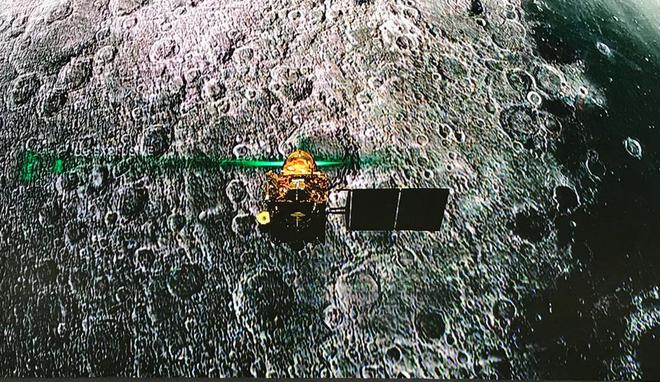
Welcome to The Hindu’s live coverage of the soft-landing of the Vikram lander on the south pole of the lunar surface, the first attempt by any country.
Unfortunately communication has been lost with the Vikram lander as it was at the altitude of about 2 km. Data is being analysed, ISRO Chairman K. Sivan said.
“Let's hope for the best,” Prime Minister Narendra Modi told those gathered at the ISRO communication centre — scientists, invitees and schoolchildren.
Vikram’s touchdown was scheduled between 1.30 a.m. and 2.30 a.m. And the rollout of the rover Pragyan was to happen between 5.30 a.m and 6.30 a.m.
From the Prime Minister to opposition leaders everyone stood beside our scientists.
2.30 A.M.
A spokesman told the gathered media corps that they cannot say how long it might take to know what happened to Vikram.
2.20 A.M.
Let's hope for the best, says Modi
Focus has now shifted to Mr. Modi. The Prime Minister is seen interacting with the scientists. Mr. Modi tells Mr. Sivan: “Be brave.” He is giving some pep talk to those gathered there. “Let's hope for the best. Wish you all the best,” he tells the scientists. He is now interacting with the schoolchildren who earned a place here after winning an ISRO quiz.
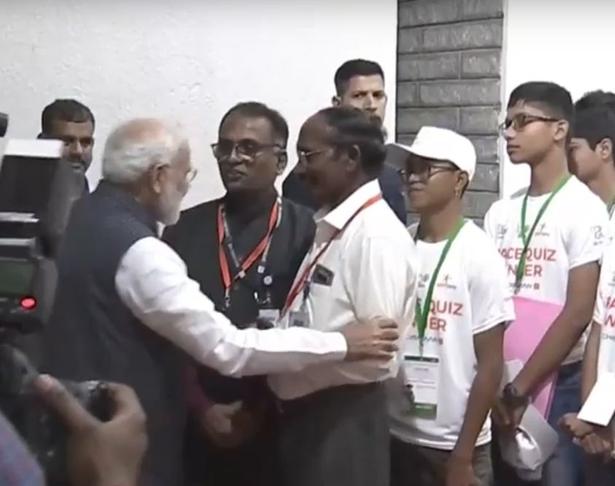
After this, the Prime Minister has left the venue.
2.16 P.M.
Communication lost with Vikram: ISRO
ISRO chief K. Sivan: “Vikram lander descent was as planned and normal performance observed up to an altitude of 2.1 km. Subsequently, communications from lander to the ground station was lost. The data is being analysed.”
2.07 A.M.
Some cheers could be heard. Someone said data. But nothing is clear yet. Tense moments continue. It seems communication has been restored with Vikram. But no word on any data.
Back to tense silence.
1.59 A.M.
No announcements yet. The Prime Minister is seen leaving from where he was seated after the briefing by the ISRO Chairman. An announcement has been made to all in the hall to return to their seats. We can spot at least three former ISRO chiefs. No one is smiling.
The scheduled touchdown time of has come and gone. ISRO yet to hear from Vikram.
 1.51 A.M.
Vikram has now completed its rough and fine braking phases. It's now in the vertical descent phase. Two more minutes to go.
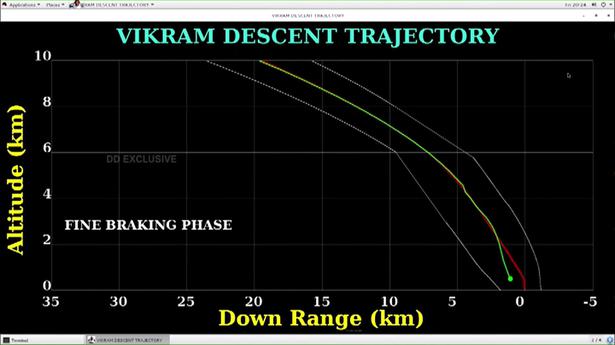
Tense moments pass. No updates are being given. Mr. Sivan is now briefing the Prime Minister.
Moments of applause has given way to a grim mood. Fingers crossed.
1.38 A.M.
Vikram begins descent
Lander Vikram descent phase has been initiated. Four engines have been fired. In another 15 minutes it will make touchdown. In a sign of everything going good, the lander’s velocity is being reduced phase by phase. Scientists are seen applauding. Good sign.
1.25 A.M.
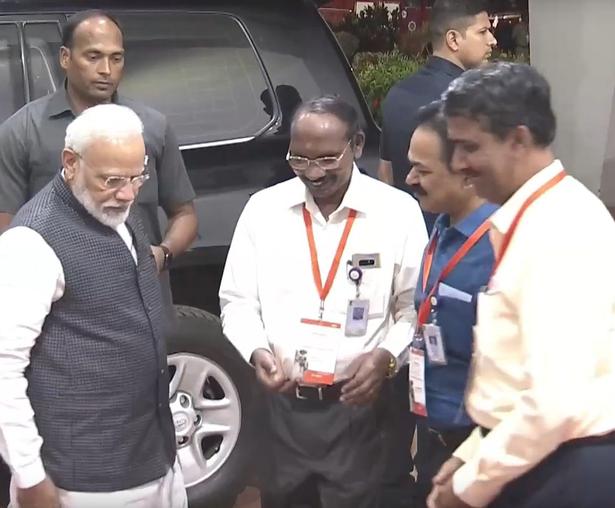
Prime Minister Narendra Modi has arrived to witness the landing.
 1.15 A.M.
In less than 25 minutes the power descent of Vikram Lander will begin. In another 15 crucial minutes Vikram will land on the moon.
1 A.M.
What happens during ‘15 minutes of terror’?
At an opportune moment, when Vikram is at an altitude of 30 km, ISTRAC engineers will give commands to the five throttleable engines on board the lander to fire
The lander begins its descent, performs a series of braking manoeuvres to control its descent and lands softly on the moon
Each of the five throttleable engines has a thrust of 800 Newtons. They will decelerate Vikram in stages as it comes down towards the moon’s surface
As Propulsion Today, an ISRO publication, says: “This is the most crucial phase of the mission when the soft-landing is executed.”
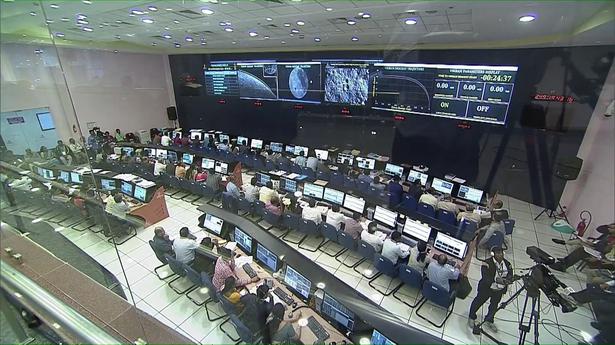
The throttleable engines are used for the lander’s “orbit correction, de-boost, and rough, precision and final braking manoeuvres”, explains Propulsion Today. The final touchdown is from “a height of two metres where the engines will be shut off and the lander is allowed to fall free.” The lander, with the rover inside, should touch down with a sufficiently low velocity. The IPRC developed the throttleable engines. There are sensors on board the lander, which will decide where Vikram should touch down: in an area where there are no craters, boulders and steep slopes. The slopes should not have an inclination of more than 12 degrees. Otherwise, Vikram will topple. It will take 15 minutes for Vikram to descend the 30 km touchdown.
“These 15 minutes of terror,” as Mr. Sivan called them, would constitute the most complex mission for ISRO.
Read the full story from our sister publication Frontline.
According to ISRO, a total number of 38 soft-landing attempts have been made, so far. The success rate is 52%.
12.45 A.M.
Chandrayaan 1 vs Chandryaan 2
Chandrayaan 2 is a follow-on mission to the Chandrayaan 1 Mission. Chandryaan-2 comprises of an Orbiter, Lander (Vikram) and Rover (Pragyaan). Unlike Chandrayaan-1, Chandrayaan-2 will attempt to soft land its Vikram module on the lunar surface and deploy a six-wheeled Rover, Pragyaan on the Moon to carry out several scientific experiments. The lift-off mass of Chandrayaan-1 was 1380 kg while Chandrayaan-2 weighs 3850 kg.
Some of the technological challenges of Chandryaan mission are:
The propulsion system consisting of throttleable engines to ensure landing at low touch down velocity
Mission management - propellant management at various stages, engine burns, orbit and trajectory design
Lander Development - Navigation, guidance and control, sensors for navigation and hazard avoidance, communication systems and lander leg mechanism for soft landing
Rover Development - Roll down (from the lander) mechanism, roving mechanism (on the lunar surface), development and testing of power systems, thermal systems, communication and mobility systems.
2.30 A.M.
Media experience Mangalyaan vs Chandrayaan 2
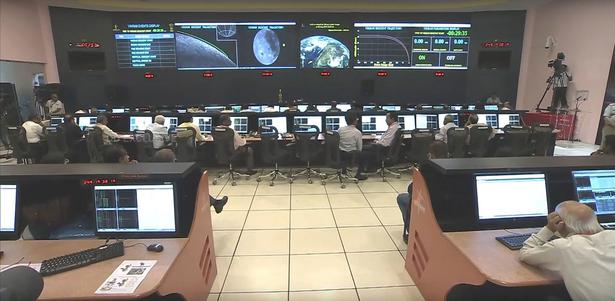
The last time an event of such scale took place at ISTRAC was during the launch of India's Mangalyaan Mars Mission. Journalists were taken right into the thick of action, with just a glass wall separating them and the crew working on the mission. This time, however, the media (around 300 journalists) is housed at a separate location: the Satellite Control Centre of ISRO.
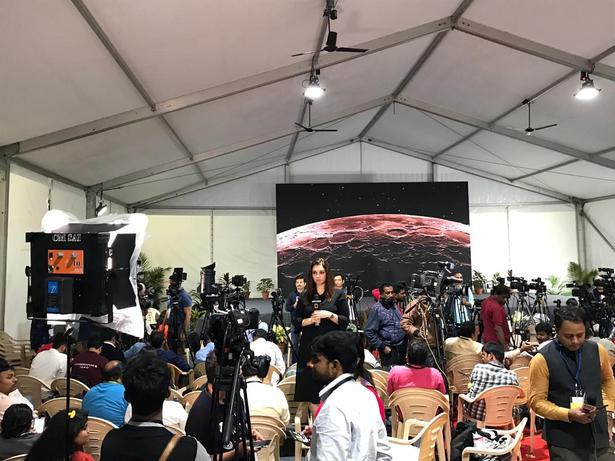
All the “action” takes place inside MOX — Mission Operations Complex — where the Prime Minister, mission managers, scientists and invitees will be housed .
12.15 A.M.
Divine blessings
The ISRO chairman offered special prayers at the Sri Krishna mutt in Udupi on July 7 and the Lord Venkateswara temple at Tirumala in Tirupati on July 13 ahead of Chandrayaan 2 launch.
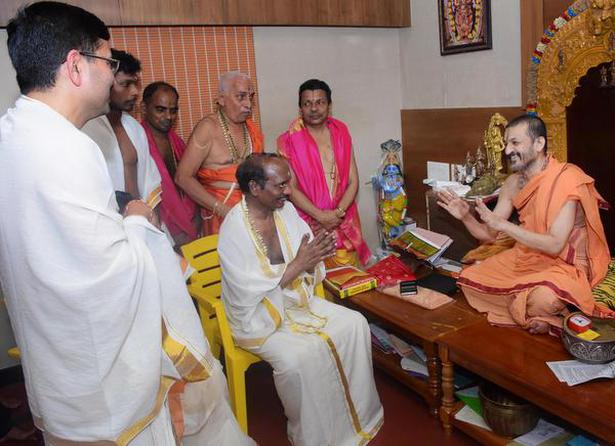
Meanwhile, special prayers were held at a Tamil Nadu temple to seek divine blessings for the lunar touchdown.
Seeking Moon god Chandra’s blessings for the successful landing of Vikram, special prayers were held at the Chandranaar Temple in Tamil Nadu’s Thanjavur district, a temple official said. “We had a special abhishekam and archana (on September 6 evening), seeking the divine blessings of Chandran,” said V. Kannan, Manager at the Sri Kailasanathan Temple or the Chandranaar Temple.
A special pooja was also organised for the success of Chandrayaan 1 before the rocket lifted off in 2008, he said.
“We didn’t offer any special prayers before July 15 when Chandrayaan 2 was first planned to be launched. Owing to some technical problem, the launch was postponed,” Mr. Kannan said. “We thought the technical snag may be due to the non-offering of prayers to the Moon God. Hence, prior to the Chandrayaan 2 launch on July 22, special prayers, abhishekam and annadhanam were conducted.”
He said the special prayers were their contribution for India going forward in its scientific programme.
While the presiding deity at the temple is Soma (Moon), the main deity is Lord Shiva.
The Chandranaar Temple is one of the Navagraha temples, all located near Kumbakonam, and devotees pray at these temples to get rid of negative planetary influence on them. The nine Navagraha temples are: Suryanaar (Sun), Chandranaar (Moon), Angaragan (Mars), Budhan (Mercury), Guru (Jupiter), Sukran (Venus), Shani (Saturn), Rahu and Ketu.
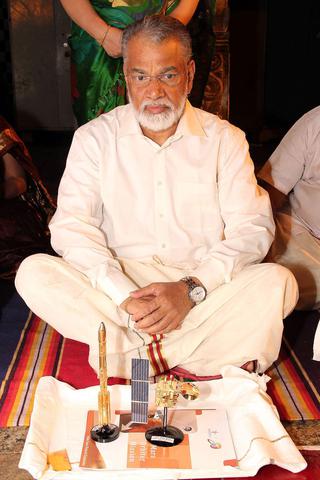
In 2013, then ISRO Chairman K. Radhakrishnan carried models of the PSLV C-25 and the Mars Orbiter while praying at Sri Venkateswara temple at Tirumala.
 12 A.M.
What is special about Chandrayaan 2?
Chandrayaan 2 will be the first mission to reach and study the south pole of the moon. It is made up of an orbiter, a lander named ‘Vikram’, after Vikram A. Sarabhai, the founding father of space science research in India, and a rover named ‘Pragyan’, which means ‘wisdom’. At about 3,877 kg, the spacecraft weighs nearly four times its predecessor, Chandrayaan 1. It will be launched by the GSLV Mark III, the Indian Space Research Organisation’s (ISRO’s) most powerful and massive launcher. While Chandrayaan 1 sent its lander crashing into the moon, Chandrayaan 2 will use rocket technology to soft land ‘Vikram’, carrying its ‘Pragyan’ rover in a suitable high plain on the lunar surface, between two craters, Manzinus-C and Simpelius N, at a latitude of about 70º South. This landing is scheduled for September 6 this year. The total cost of the project is about ₹978 crore. The lander-rover combo has an expected lifetime of 14 days, while the orbiter will continue for a year.
11.30 P.M.
13 Indian payloads, one from NASA
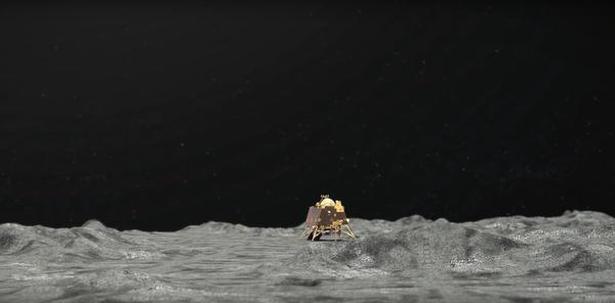
The Chandrayaan 2 mission has carried 14 payloads or study devices. Out of a total of 14 instruments in the composite module, 13 are Indian payloads and one payload is from NASA.
The orbiter, which weighs 2.4 tonnes, has eight instruments. From its 100-km orbit around the moon, its terrain-mapping camera and high-resolution camera can take pictures of the moon’s surface. Its imaging infrared spectrometer will look for minerals. The orbiter’s instruments will especially look for rock-forming elements such as magnesium, calcium, iron, and so on. Its synthetic aperture radar will hunt for buried water-ice on the Moon. Another instrument will study the Moon’s exosphere. Indeed, in a huge breakthrough, Chandrayaan 1 had discovered water-ice on the moon. ISRO chief Mr. Sivan described it as “the greatest achievement of the Chandrayaan 1 mission”.
The lander, which weighs 1.4 tonnes, has four payloads, including the one from NASA. The three Indian instruments will conduct experiments on lunar quakes and study the landing sites’ thermo-physical properties. The payload for studying the moon’s seismic activity is called Instrument for Lunar Seismic Activity. The NASA payload, a last-minute addition, is called Laser Retroreflector Array. It will try to understand the dynamics of the earth-moon system and measure the distance from the lander on the moon to the earth.
The rover, which weighs about 27 kg, has two payloads including an Alpha Particle X-ray Spectrometer. They will compute the mineral and chemical composition of the moon’s surface.
10.50 P.M.
Modi arrives in Bengaluru
Prime Minister Narendra Modi has landed in Bengaluru to witness the historic lunar landing.
“Modi landed at the Yelahanka base of the IAF on the city’s northern outskirts at 9.40 p.m. for an overnight stay at a star hotel, which is near to the space agency’s network centre to witness Vikram’s landing on the moon between 1.30-2.30 a.m.,” an official said.
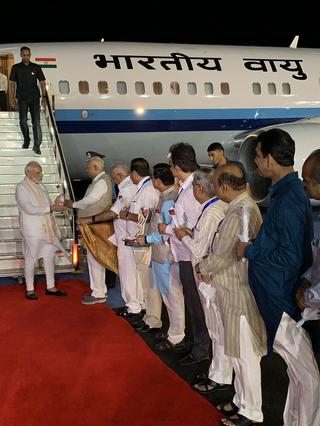
Governor Vajubhai Vala, Chief Minister B.S. Yediyurappa, city Mayor Gangambike Mallikarjun, Union Ministers D.V. Sadananda Gowda and Pralhad Joshi, ruling BJP’s state unit President Nalin Kumar Kateel and top officials were present at the air base to welcome Mr. Modi.
“Modi will drive to the Indian Space Research Organisation’s (ISRO) Telemetry, Tracking and Command Network (Istrac) in the Peenya industrial area of the city’s northwest suburb by 1.00 a.m. and return to the hotel after watching the landing by 3.00 a.m.,” added the VIP protocol official.
Mr. Modi will also interact with about 70 students from across the country at the network centre after Vikram’s landing and address them.
10.45 P.M.
Vikram lands on moon on the 50th anniversary year of the Giant Leap
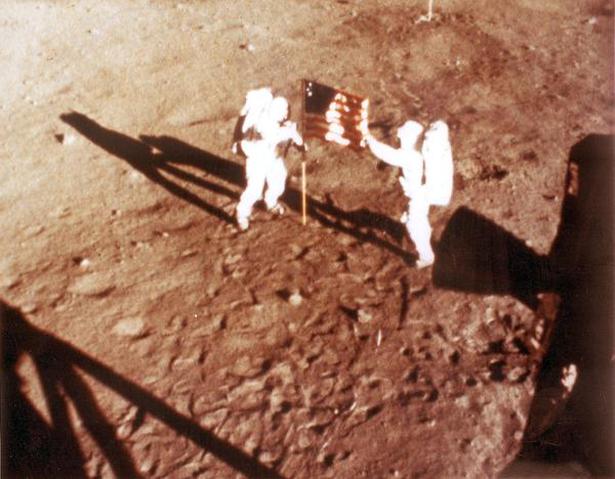
The year of Vikram's touchdown also happens to be the 50th anniversary of the first lunar landing. Take The Hindu Science Quiz, to check how much you knew about NASA's Apollo missions, Chandrayaan and more.
10.30 P.M.
ISRO’s lunar touchdown has dry run on soil fetched from Tamil Nadu
Newly designed cars are tested for road-worthiness on terrain where they would be driven, while new aircraft are test-flown in the skies. But where on earth did the Chandrayaan-2 mission’s lander and rover, which will head for the moon on July 15, check out their legs and wheels?
More than a decade ago, even as the Chandrayaan-1 orbiter mission of 2008 was being readied, the Indian Space Research Organisation (ISRO) created a proto-Lunar Terrain Test Facility (LTTF) at its advanced satellite testing unit, ISITE, in Bengaluru. This, it did, by modifying a balloon research lab, about 30-40 m high, long and wide.
At the time, ISRO was grappling with the task of indigenously executing the cryogenic stage for its GSLV MkII rocket. Any thought of sending a moon lander was a distant dream of low priority. Equipping the LTTF and making it look and feel like being on the moon was the first challenge. It needed lunar ‘soil’ with almost all its features and texture, lunar temperatures, low gravity and the same amount of sunlight as on the moon.
For recreating the terrain, an option was to import simulated lunar soil from the U.S. — at an exorbitant $150 a kg (the then prevailing price). The facility needed about 60-70 tonnes of soil.
10.15 P.M.
‘It's like placing a baby on the cradle’
“Certainly there is lot of anxiety in the minds of the entire (Chandrayaan 2) team because it’s a very complex operation and we are doing it for the first time.” This is how a senior official associated with the mission, told news agency PTI on condition of anonymity, earlier in the day.
“Everything... sensors, computers, command systems... has to work perfectly. But we are confident in the sense we have conducted a large number of simulations on the ground; it gives us the confidence it would go alright,” the official said.
He described the soft-landing as “almost like placing a baby on the cradle,” and said, “There is certain amount of anxiety but there is no fear.”
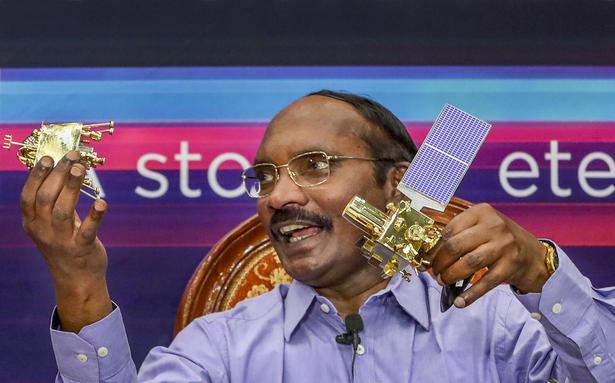
ISRO chief K. Sivan too used the baby reference to describe the landing. “It is like suddenly somebody comes and gives you a newborn baby in your hands. Will you be able to hold without proper support?” news agency AFP quoted Mr. Sivan as telling news channel NDTV. “The baby will move this way, that way but we should hold it,” he said.
10 P.M.
U.S. space scientists excited, media takes note of lunar landing
Moon’s south pole could become one of the most important places on the moon’s surface, said Space.Com, adding that it will become the southernmost spot on the moon to be visited by a spacecraft.
Brett Denevi, a planetary scientist at Johns Hopkins University Applied Physics Laboratory told scientific journal Nature: “The Chandrayaan 2 landing site will be in completely new terrain.” Ms. Denevi said she was most excited about the orbiter’s imaging infrared spectrometer, which will map light reflected off the lunar surface over a wide range of wavelengths. This information can be used to identify and quantify surface water, which absorbs light strongly at certain wavelengths, she said.
Chandrayaan 2 carries 13 instruments from India and one from NASA.
For Dave Williams, a planetary scientist at NASA, the Chandrayaan 2 mission would help answer several crucial questions. “We’ve surveyed the moon pretty extensively from orbit, but there’s nothing like actually being there,” he told American magazine Wired. The Chandrayaan 2 mission is a point of national pride for India, it said.
The New York Times noted on September 5 that Chandrayaan 2 was “relatively inexpensive” compared with other space missions. “It cost less than USD 150 million, cheaper than the budget to make the 2014 Hollywood film “Interstellar”, the daily reported. “The South Pole of the moon is interesting to scientists because of the possibility that water ice could be there. That could be useful for moon habitation and making fuel for exploring Mars. Scientists also want to look for deposits of helium-3, potentially a future energy source for Earth,” the New York Times said.
“India is one step closer to achieving its space superpower ambitions,” CNN reported on September 5, adding that the country will join the elite club of the United States, China and Russia that have made soft landing on the moon. “India’s entrance into space exploration over the last decade has been marked by a series of missions at low operation costs,” the news channel said.
Scientists hope to gain a better understanding of the origins of the deposits and determine whether it might be possible to mine them to obtain water for future space missions, Timothy Swindle, director of the Lunar and Planetary Laboratory at the University of Arizona in Tucson told NBC news. “We know that there’s water there, but we don’t know very much about it — how much there is, how it got there,” Mr. Swindle was quoted as saying. “The more we can learn, the better, in part because if we want to explore the moon that would be a really great resource for human exploration,” he said
9.30 P.M.
‘15 minutes of terror’
Indicating the challenges involved in soft landing, ISRO chairman K. Sivan had said the space agency’s scientists will undergo about “15 minutes of terror (filled moments).”
“Chandrayaan 2 is the next leap in technology as we attempt to soft land close to South Pole of Moon. The soft landing is extremely complex and we will experience approximately 15 minutes of terror,” Mr. Sivan said after offering prayers at the hill shrine of Lord Venkateshwara at Tirumala on July 13.
On September 6 he said: “We are eagerly waiting for the event. Everything is going according to the plan.”
9.20 P.M.
How does Pragyan function?
Hours after touchdown, rover Pragyaan will roll out from inside the lander to carry out intense probe of the moon soil with its two payloads.
ISRO has come out with a video explaining Pragyan’s different parts and how it functions.
Pragyan, the cubical rover, exclusively designed for travelling on the moon, is fitted with a solar panel.Two navigation cameras, which could be called as its left and right eye, are mounted on top of it besides an Alpha particle X-ray spectrometer, receive and transmit antenna and rocker bogie assembly.
Hours after the touchdown Vikrams door will open creating a slope for the matchbox shaped rover with six-wheels to slide and move around the lunar surface to carry out various investigations.
Soon after rolling on the moon soil, Pragyaans battery will be activated to release its solar panel.
The scans of the rover will be relayed to Vikram and then earth and it will be processed at mission control for path planning.
Subsequently, instructions for the rovers movement will be transmitted back to it.
The six wheels of the rover are attached with ’rocker bogie’ to overcome obstacles as it moves forward.
It can even cross obstacles at ease with a movement range of 50 mm upwards and downwards, according to ISRO.
While controlling its movement, the Mission Control Station of the ISRO will pass on instructions to Pragyaan to stop and determine the elemental composition of lunar rocks and soil using a payload called APXS on the front, right below the two cameras.
There will be another payload called LIBS just below the cubical shaped rovers body near the right side frontal wheel to derive the elemental composition of the lunar surface.
The rover will move around at a maximum range of 500 metres from Vikram.
Its mission period is of 14 earth days during which time, various tests will be conducted.
The mission objective is to locate presence of water and other important minerals on the lunar surface.
9.15 P.M.
Chandrayaan mission is for the planet, says astronaut Jerry Linenger
Jerry Linenger, a former NASA astronaut, is in Mumbai decoding the moon landing of Chandrayaan 2 for viewers on National Geographic channel. Calling the September 7 landing an edge of the seat experience for himself, Mr. Linenger wants to tell Indian audiences especially students how difficult it is to craft and execute such a mission.
9 P.M.
Why go to the Moon?
“The moon offers a pristine environment to study. It is also closer than other celestial bodies. Understanding how it formed and evolved can help us better understand the solar system and even earth itself. With space travel taking shape and exoplanets being discovered everyday, learning more about earth’s celestial neighbour can help in advanced missions. Finally, it is a piece of the larger puzzle as to how the solar system and its planets have evolved,” explains our science correspondent Shubashree Desikan. Read her explainer here.
ISRO sums up the rationale behind the mission thus:
“The Moon is the closest cosmic body at which space discovery can be attempted and documented. It is also a promising test bed to demonstrate technologies required for deep-space missions. Chandrayaan 2 attempts to foster a new age of discovery, increase our understanding of space, stimulate the advancement of technology, promote global alliances, and inspire a future generation of explorers and scientists.
“Moon provides the best linkage to Earth’s early history. It offers an undisturbed historical record of the inner Solar system environment. Though there are a few mature models, the origin of Moon still needs further explanations. Extensive mapping of lunar surface to study variations in lunar surface composition is essential to trace back the origin and evolution of the Moon. Evidence for water molecules discovered by Chandrayaan-1, requires further studies on the extent of water molecule distribution on the surface, below the surface and in the tenuous lunar exosphere to address the origin of water on Moon.
“The lunar South Pole is especially interesting because of the lunar surface area here that remains in shadow is much larger than that at the North Pole. There is a possibility of the presence of water in permanently shadowed areas around it. In addition, South Pole region has craters that are cold traps and contain a fossil record of the early Solar System.”
8.45 P.M.
How will Vikram set foot on the moon
In the run-up to Vikram's rendezvous with moon, watch this ISRO video to find out more about Vikram and the different stages of its journey to the moon’s south polar region!
8.30 P.M.
ISRO, orbiter, lander, rover indulge in banter ahead of touchdown
Hours before the crucial touchdown of Vikram, ISRO has come out with the Chandrayaan 2 chronicles indulging in banter involving the orbiter, lander and rover Pragyan.
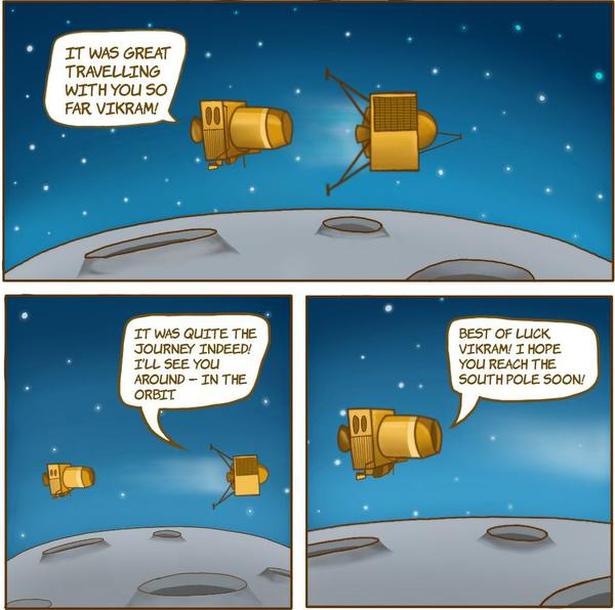
ISRO tweeted a comic strip showing orbiter telling the lander Vikram that it enjoyed its company before it separated on September 2 afternoon.
“It was great travelling with you so far, Vikram,” the orbiter tells the moon lander.
Vikram reciprocated with the same gusto: “It was quite the journey indeed! I’ll see you around-in the orbit.”
source:www.thehindu.com


